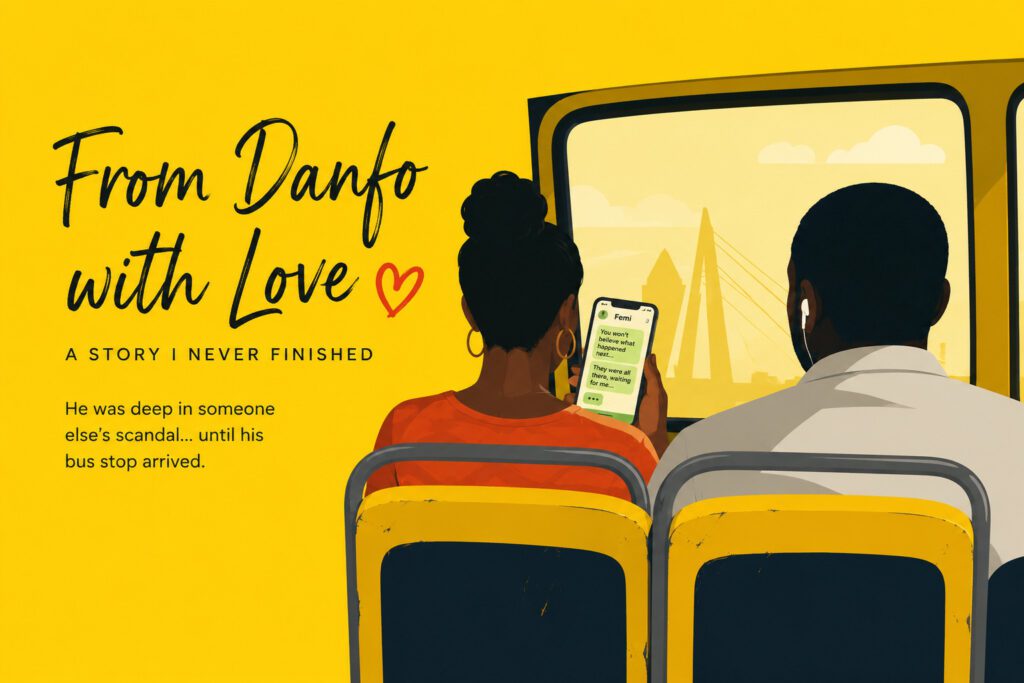
My heart hammered against my ribs, a frantic, syncopated rhythm that had nothing to do with the danfo driver’s reckless navigation. He swerved between two looming trailers with the terrifying confidence of a man who believed he had personally brokered a truce with the laws of physics. Beside us, the conductor hung precariously out the door, his body a blur of motion as he slapped the rusted yellow metal and barked destinations like a desperate town crier. We were trapped in the familiar, suffocating red sea of Lagos traffic—an agonizing, stop-and-start crawl where hawkers peddled everything from chilled water to steering wheel covers through half-rolled windows.
But the anxiety clawing at my throat was not born of the gridlock. It was the crushing weight of a narrative I didn’t want to end.
If there is one absolute, immutable truth I have learned about women, it is that they are the keepers of everything. They are the archivists of the heart: the dates, the promises, the exact phrasing of a casual text from six months ago, and the specific emoji chosen to dilute the poison of an apology.
This is Femi’s story. And according to his confession, his downfall was a masterclass in hubris. It began innocently enough. There was Lola, met at a party in Surulere, whose laughter became his favorite addictive vice. Then there was Kemi, a banker with the cold, meticulous grace of a woman who curated her life like a portfolio. Finally, there was Ada, a woman who didn’t just enter a room—she ignited it.
I had convinced myself I was a master architect of lives, a project manager of deceit. I used the chaos of Lagos as my accomplice, relying on the vast, unforgiving distances to keep my three worlds from colliding. I lived by color-coded calendars, rehearsed alibis, and the frantic exhaustion of a man trying to outrun his own shadow.
I thought I was winning until the boundaries began to blur. My fatal error? Sending a voice note intended for Lola into Ada’s chat. The blue ticks that followed were not just a confirmation of receipt; they were a death warrant.
As I sat there, the heat of the Lagos afternoon pressing through the glass, I was deep in the digital pages of my own ruin. I had foolishly convinced myself that I could manage three separate “brunch” invites, spacing them out by mere minutes.
But I hadn’t accounted for their collective intelligence.
I was currently waiting in my apartment, believing I had successfully dodged the bullet by feigning a “sudden business emergency” to cancel the meetings. The text on the screen showed me checking my watch, satisfied with my own cleverness.
Then came the turn.
A notification from Lola: “I’m at your gate, Femi. Open up.”
My stomach dropped. I went to type a lie—“I’m not home”—when another ping hit. This time from Kemi: “Don’t bother lying. I see your car in the driveway. And so does Ada.”
My hands were shaking as I typed back: “What do you mean, Ada?”
The screen flickered. A high-resolution photo appeared in the chat history. It was a picture taken from the balcony of my own apartment building. It showed three distinct figures standing together at my front door—Lola, Kemi, and Ada—looking up at my window.
The final message from the group chat they had apparently formed behind my back was a single, chilling instruction: “We have the spare key you gave each of us. We are coming in, Femi. Don’t run.”
“Oshodi! Oshodi! Anybody wey dey come down, come down!”
The conductor’s shout hit me like a splash of ice water. The screen went frantic as the man on the screen—Femi—began typing a desperate, incoherent plea, his cursor blinking erratically.
I blinked, dazed. The terror in that apartment, the three women on the threshold, the silence of a man caught in the ultimate trap—it all dissolved into the noisy, humid reality of the danfo.
The woman sitting in the seat directly ahead of me hadn’t moved. She remained slumped in her corner, her thumb hovering over the screen, completely absorbed in the digital bloodbath. Every movement of her finger was the cadence of a life ending, every pause in traffic a new, agonizing chapter of a reckoning I was no longer allowed to witness.
“Oga, na your bus stop be this,” the conductor barked again, his hand gripping the door frame, waiting for me to move.
I looked at the phone with a desperate, hungry intensity, praying for just one more scroll, one more revelation. I needed to see the door open. I needed to see the look on his face when the three of them walked in.
But the bus shuddered, the door folding open with a mechanical groan. I had no choice. I stepped down onto the dusty roadside, my feet hitting the pavement with a jarring thud.
As the danfo lurched back into the endless, snarling artery of Lagos traffic, I craned my neck. Through the grimy rear window, I saw the woman’s thumb move again, scrolling further down. She was still reading. She was still there, watching the end of the world from the safety of a yellow seat, while I was left standing on the shoulder of the road, forever a stranger to the final act of a story I thought was mine.