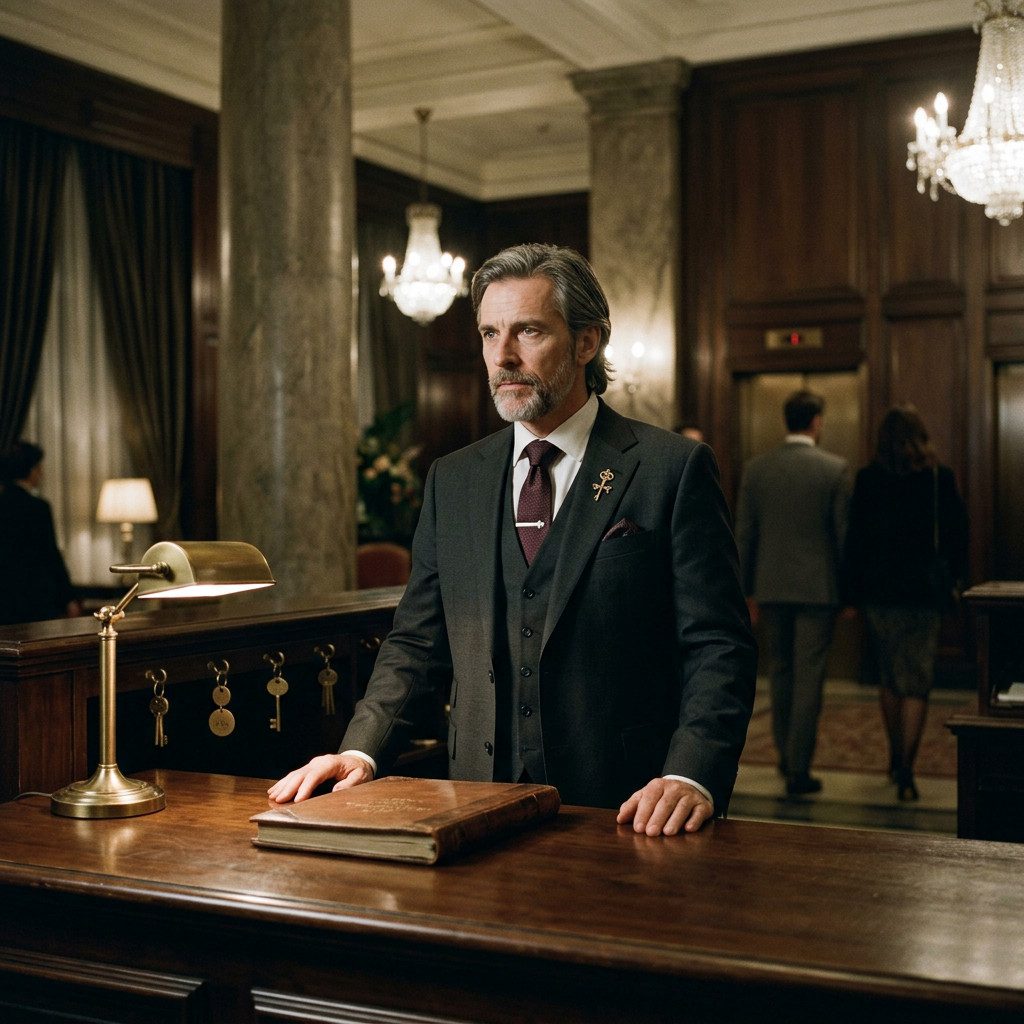
The afternoon crowd drifted lazily through the Atlantic Crown. Business travellers arrived with wheeled suitcases and tired smiles. A bride’s entourage filled one corner of the lobby with laughter. Somewhere near the restaurant entrance, a pianist coaxed “Joromi” from an old grand piano, and for a brief moment the hotel felt exactly like what the world believed it to be.
Tunde stood behind the reception desk, answering questions about airport transfers and late check-outs with the same quiet professionalism he had displayed every day for the past eleven years.
No one ever remembered his face after leaving.
He had worked very hard to ensure that.
Just before four o’clock, the television mounted above the hotel bar interrupted its programming with a red BREAKING NEWS banner.
The barman instinctively raised the volume.
“…we have just received confirmation that prominent businessman and shipping magnate Alhaji Suleiman Dogo has died following what authorities are describing as a tragic motor accident along the Lekki-Epe Expressway earlier this afternoon.”
Images filled the screen. A black Lexus SUV lay crushed against the central barrier, its bonnet folded into itself like crumpled paper. Uniformed officers struggled to keep curious onlookers away while a reporter narrated the scene with practiced solemnity.
“The Federal Road Safety Corps believes a front tyre burst at high speed before the driver lost control. Investigations are continuing.”
Around the lobby, conversations slowed for only a few seconds before returning to weddings, business meetings and delayed flights. Lagos had long ago learned that tragedy was simply another headline competing for attention.
The bartender looked up from the crystal tumbler he was polishing.
“Second major accident in two days,” he murmured. “First the explosion in Apapa, now this.”
Tunde glanced briefly at the screen.
“It would seem so.”
“You don’t believe it?”
Tunde smiled politely.
“I’ve found that the truth and the news often maintain a respectful distance from each other.”
The bartender laughed, assuming it was another of Tunde’s dry observations, and returned to his work.
Only Tunde’s eyes lingered on the broadcast a fraction longer than anyone else’s.
The camera zoomed in on the wrecked vehicle.
To everyone else it looked like an ordinary collision.
To him, one detail immediately stood out.
There were no impact fractures on the driver’s side window.
Someone had removed the glass before the crash.
Neatly.
Professionally.
Whoever had arranged the accident had wanted a clean shot.
He wondered, not for the first time, whether the police would ever learn to distinguish between an accident scene and an execution.
Probably not.
That ignorance kept everyone employed.
Mrs. Adebayo emerged quietly from the staff corridor carrying the hotel’s leather-bound ledger beneath one arm. Although she officially managed guest services, everyone in the Continental understood that she answered to people whose names were never spoken aloud.
She stopped beside the reception desk without looking at Tunde.
“The Apapa guest has checked out?”
“He left shortly after noon.”
“And everything proceeded according to protocol?”
“As always.”
She nodded, seemingly satisfied, but made no move to leave. Instead, she opened the ledger to its final pages, where room accounts gave way to records that no accountant would ever audit.
Her finger traced a recently completed entry.
Contract 1847.
Client: Settled.
Target: Suleiman Dogo.
For the first time that afternoon, she frowned.
“That’s curious.”
Tunde continued arranging room keys inside their numbered compartments.
“What is?”
“The assignment was completed an hour ago.”
“So I hear.”
She looked at him over the rim of her glasses.
“I wasn’t informed another operative had accepted it.”
“There wasn’t.”
She studied him for several moments. Years earlier she had stopped trying to decide whether Tunde enjoyed these conversations or merely tolerated them.
“The timing is remarkable,” she said carefully. “Mr. Dogo happened to leave his office at exactly the moment our guest departed the hotel.”
“So the news suggests.”
“And the surveillance cameras lost sight of you for precisely eleven minutes.”
Tunde finally looked up.
“I was buying coffee.”
She almost smiled.
“The café was in the opposite direction.”
“The queue was shorter.”
A silence settled comfortably between them.
It was the silence of two people who had known one another for decades and no longer needed explanations.
Mrs. Adebayo closed the ledger with a gentle thud.
“You know,” she said, “there are over four hundred registered assassins operating across Africa. Every intelligence agency has spent years trying to identify the one they call Ẹkùn.”
Tunde said nothing.
“They believe Ẹkùn is a former special forces officer.”
She waited.
“Some think he is an entire organisation.”
Still nothing.
“The High Table is convinced he has been dead for years.”
Tunde picked up a brass room key and polished it with a white cloth until it reflected the chandelier above him.
“They’ve constructed quite an interesting legend.”
Mrs. Adebayo watched him with something between admiration and resignation.
“The amusing part,” she said softly, “is that the greatest assassin on the continent spends most of his day recommending restaurants to tourists and helping newlyweds with their luggage.”
A young couple approached the reception desk before Tunde could answer.
The husband smiled apologetically.
“Excuse me, sir. Could you recommend somewhere nearby for good pepper soup?”
Tunde’s face brightened with the effortless warmth that thousands of guests had come to trust.
“I know exactly the place.”
He circled a location on a tourist map, gave directions, wished them a pleasant evening and accepted their grateful thanks as though it were the most important conversation he would have all day.
When they had gone, Mrs. Adebayo simply shook her head.
“They’ll never suspect you.”
“They never notice the concierge.”
“No.”
She smiled to herself as she turned towards her office.
“They only remember the men carrying guns.”
Tunde watched another guest step through the revolving doors, adjusted his tie, and returned to the quiet rhythm of checking passports, assigning rooms and answering questions.
Outside, Lagos continued to roar with its endless symphony of traffic, commerce and ambition.
Inside, the most dangerous man in Africa welcomed strangers with impeccable manners, served excellent coffee, and made certain everyone enjoyed a comfortable stay.
It was, he often reflected, the perfect disguise. A concierge was expected to know everyone, go everywhere and remain invisible while doing so.
For a man whose greatest weapon had always been invisibility, there could hardly have been a better profession.