The first time Tunde saw the woman, she was standing beneath the faded timetable at Jibowu Motor Park, studying it with the concentration of someone trying to remember rather than trying to read.
He would later struggle to explain what had happened inside him at that moment. It was not attraction, though she possessed the quiet grace that often turned heads without asking for them. Neither was it surprise, for surprise belonged to encounters with the unexpected. This was something older and stranger. It felt like recognition stripped of memory, as though some forgotten part of himself had reached forward before his mind had caught up.
He stopped walking.
Behind him, a conductor cursed because he had blocked the narrow path between two buses. A hawker carrying oranges brushed against his shoulder without apologizing. The familiar orchestra of Lagos carried on around him: impatient horns, engines coughing smoke into the afternoon, traders announcing impossible bargains with the confidence of evangelists. Yet the sounds seemed to retreat behind glass.
The woman looked up.
For the briefest instant, confusion crossed her face before softening into the same bewildered recognition that had seized him.
She frowned slightly, not because she knew him, but because she felt she ought to.
Neither spoke.
A bus pulled in between them, its metal body rattling so violently that it seemed held together more by habit than by bolts. Passengers poured out. Others climbed in before the first group had completely descended. By the time the bus moved again, the woman was gone.
Tunde searched the terminal until evening.
He never found her.
That night, he returned to the dream.
It had begun six months earlier, on an ordinary Tuesday whose details he had long forgotten except for what came after sleep claimed him. Since then, not a single night had passed without the dream returning exactly as before. Nothing changed. Nothing shifted. It unfolded with such perfect repetition that it seemed less like imagination than memory.
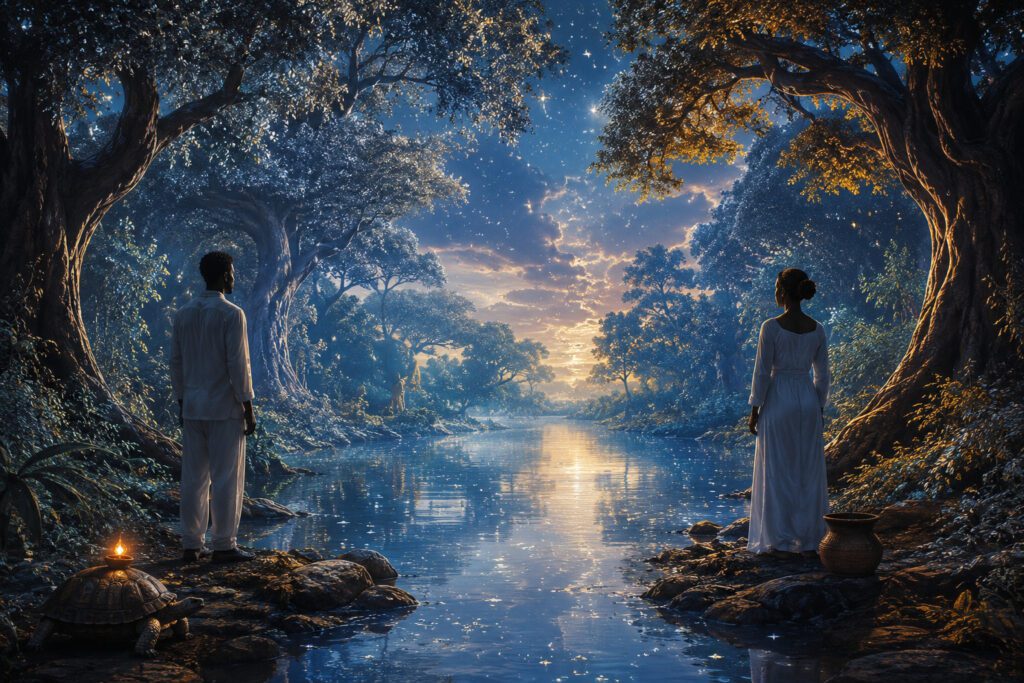
He always found himself standing on the edge of a narrow footpath that wound through a forest unlike any place he had ever seen in waking life. The trees rose impossibly high, their trunks broad enough to hide houses within them. Their leaves shimmered with a pale silver glow although no moon hung above them. Somewhere unseen, water moved with the patient rhythm of an old storyteller. The air carried the scent of wet earth after rain, mixed with the sweetness of ripe oranges.
He never questioned how he had arrived there.
He simply walked.
The path curved gently until it opened onto a wide river whose surface reflected not the forest but a sky crowded with unfamiliar stars. On the opposite bank stood a woman dressed in plain white wrappers. Her back was turned. Beside her rested an empty calabash.
Without looking around, she spoke.
“You are late.”
The words were neither accusation nor complaint. They carried the weary affection of someone greeting a friend who was always arriving a little after the agreed time.
“I got lost,” he replied.
He did not know why he answered those words. He had never chosen them. They seemed to belong to the place itself.
The woman laughed softly.
Then she turned, but before he could see her face clearly, a tortoise emerged from the undergrowth carrying a burning palm nut between its jaws. The tiny flame neither consumed the shell nor scorched the creature’s mouth. It crossed the narrow stretch between them with slow, deliberate steps.
When it reached the riverbank, it stopped.
The woman pointed across the water.
“There.”
Tunde followed her finger.
He never saw what she wished him to see.
When he turned back, she was gone.
Only the empty calabash remained beside the river.
Then he always woke.
Always at seventeen minutes past four.
Always with the smell of rain lingering in his room.
The dream never varied.
Not once.
For months he dismissed it as an overworked imagination. His mother advised more prayer. A colleague insisted he had watched too many films before bed. Another recommended herbal tea. None of it altered the dream. Eventually he surrendered to it, buying a small notebook in which he recorded every detail immediately after waking, though there was little point. He already knew every line by heart.
The silver leaves. The river. The calabash. The tortoise. The words. Every morning he copied them again as though afraid memory might betray him. Three days after seeing the woman at Jibowu, chance returned her to him.
He was sitting alone in a small café near Yaba, pretending to read while waiting for traffic to subside, when someone stopped beside his table.
“I hope you don’t mind.”
He looked up.
It was her.
She held a cup of coffee with both hands, though it was obvious she had forgotten to drink it.
“There aren’t any empty tables.”
He nodded.
“Please.”
She sat opposite him.
For several uneasy minutes they exchanged only the ordinary courtesies strangers borrow to protect themselves from silence. They spoke about the weather, the traffic, the endless roadworks that never seemed to end. Yet beneath every sentence lay another conversation neither knew how to begin.
Finally she placed her cup on the table.
“This will sound ridiculous.”
“I suspect mine will too.”
She smiled for the first time.
“Have we met before?”
“I don’t think so.”
“I didn’t think so either.”
Silence returned.
Then, almost reluctantly, she asked, “Do you dream?”
He laughed despite himself.
“Every night.”
“The same dream?”
His fingers tightened around his cup.
He stared at her.
“What happens in yours?”
She hesitated, as though speaking the dream aloud might somehow break it.
“There is a forest.”
He said nothing.
“The leaves are silver.”
His breathing slowed.
“I walk to a river.”
Still he remained silent.
“There is a man on the opposite bank.”
The café disappeared.
The chatter around them dissolved into distant echoes.
“He always arrives late.”
Tunde swallowed.
“What does he say?”
She lowered her eyes.
“He says he got lost.”
Neither spoke for several moments.
Then, in voices scarcely louder than whispers, they reconstructed the dream together. Every detail matched. Not almost. Exactly. The same river. The same scent after rain. The same empty calabash.
The same tortoise carrying the burning palm nut. The same pause before the woman pointed. The same single word.
“There.”
The same failure to see what lay across the water. The same disappearance. The same awakening at seventeen minutes past four. Only one difference existed. In his dream, he stood where the man stood. In hers, she stood where the woman stood. It was not two dreams. It was one dream seen from opposite shores. For weeks they searched for explanations.
They visited neurologists who found nothing unusual. A sleep specialist suggested coincidence seasoned by imagination. They laughed politely, knowing coincidence had surrendered long ago. They spent evenings comparing childhood memories, wondering whether they had crossed paths as children and forgotten. Their families came from different parts of the country. They had attended different schools. Their lives had unfolded like parallel roads that had never once intersected.
One Saturday they travelled to Òṣogbo for no reason either could clearly defend except that both had independently dreamt of an old woman sitting beneath an ìrókò tree.
The tree existed. So did the woman. She seemed unsurprised by their arrival. Before either had spoken, she looked at them with the patient expression of someone whose guests had merely arrived later than expected.
“You finally found each other.”
Neither answered.
She motioned for them to sit upon two wooden stools outside her small house.
For a long while she occupied herself with pouring water into clay cups before speaking again.
“The dream has ended.”
They looked at one another.
Only then did they realize they had slept peacefully the previous night without visiting the silver forest for the first time in six months.
“How did you know?” Amaka asked quietly.
The old woman smiled.
“Because it has served its purpose.”
She spoke neither like a prophet nor like a priestess eager to display hidden knowledge. Her voice possessed the calm certainty of someone discussing the weather.
“The world you know is not the only one that exists. Long before your fathers learned to build cities, the Òrìṣà studied human beings. They watched kingdoms rise and disappear. They watched mothers bury children and children bury mothers. They understood power. They understood sacrifice. Yet one mystery continued to escape them.”
“What mystery?” Tunde asked.
“What allows two strangers to become necessary to one another.”
She picked up a fallen leaf and turned it between her fingers.
“One among them grew dissatisfied with observing from a distance. He wished to learn, not by commanding human lives but by watching them unfold. So he fashioned a place between sleep and waking. Not heaven. Not earth. A river. He invited two strangers there every night.”
She looked from one face to the other.
“He changed nothing about your hearts. He forced no affection upon you. He merely removed the awkwardness that usually stands between strangers. By the time your waking lives met, your souls had already become accustomed to each other’s presence.”
Amaka frowned.
“So… he brought us together?”
The old woman shook her head.
“He brought you to the same doorway.”
She smiled gently.
“You chose to enter.”
The distinction settled over them like evening light.
Outside, children ran past the compound chasing a tyre with sticks. Somewhere farther away a talking drum answered another across the town. Life continued with the indifference it reserves for revelations that alter only a few people at a time.
As they prepared to leave, Tunde turned back.
“Which Òrìṣà was it?”
The old woman laughed, though there was no mockery in it.
“You think they tell us all their names?”
She watched them disappear along the dusty road before speaking one final sentence, though neither could later remember hearing it with their ears.
“The divine are still learning from those they created.”
Years later, after friendship had quietly become love and love had settled into the ordinary rhythms of shared mornings, unpaid electricity bills, forgotten shopping lists and laughter over burnt pots of soup, Tunde would sometimes wake before dawn expecting to smell rain inside the room.
The scent never returned.
Neither did the dream.
Yet on certain evenings, when Lagos traffic trapped them on the Third Mainland Bridge and the lagoon reflected the first stars of night, they would fall into a comfortable silence that required no explanation.
In those moments, each would remember a silver forest that no map could find, a river that reflected another sky, and a stranger whose face they had once been unable to see.
It occurred to Tunde, not with certainty but with quiet gratitude, that perhaps the old woman had been wrong about one thing.
The dream had not ended because the Òrìṣà had finished learning.
It had ended because the lesson no longer belonged to the Òrìṣà.
It belonged to the two strangers who had once met beside a river every night until, at last, they met beneath the unromantic roof of a Lagos motor park, where buses groaned, conductors shouted, and the sacred slipped unnoticed through the ordinary, just as it always had.